- Heat is the first habit
- Tools: what touches the surface
- Washing: the thirty-second routine
- Day one: the unboxing routine
- The parts around the coating
- The spray varnish nobody suspects
- Storage is half the lifespan
- What the science says about the coating itself
- Hard water and the white ghosts
- When a pan has earned retirement
- The care calendar
Nobody wears out a nonstick pan by cooking on it. The coating that arrives slick and dark and lets an egg slide like a hockey puck is engineered for years of heat cycles under food. What it is not engineered for is the handful of habits that have nothing to do with dinner. An empty pan forgotten on a roaring burner. A metal spatula scraping fond that was never going to stick anyway. A hot pan hissed under the cold tap. A bare stack in the cabinet grinding speckle against speckle. Remove those four habits and a granite pan becomes a five-year tool. Keep them and no coating on the market will save you. The removal manual is short, and it hangs on the wall of our own test kitchen.
Heat is the first habit
Every rule of nonstick care compresses into one sentence about temperature: the coating likes the temperatures food likes, and dislikes the ones food would burn at. Cooking happens between roughly 200 and 450 degrees Fahrenheit at the surface. A coated pan spending its life in that band shrugs off years. The damage band starts where no recipe goes: the empty pan preheating on high while the cook answers a message, drifting past every temperature dinner has ever needed.
So the first rule is simply presence and moderation: preheat for a minute or two on medium, with the oil in or the food nearly ready, and never park an empty pan on a live burner. Our die-cast aluminum bodies make moderation easy to live with, because a cast wall with a full induction disc reaches frying temperature on the middle of the dial in about two minutes. The top of the dial adds speed you do not need at a cost the coating pays. If you want the full technique this rule sits inside, the cooking guide walks the burner dial dish by dish.
The presence half of the rule is not only about the pan, and we borrow the fire administration's phrasing because it cannot be improved: stand by your pan. The same unattended burner that ages a coating is the leading cause of home cooking fires, and their prevention page is in our source lists wherever this subject comes up.
Tools: what touches the surface
The release layer is tough against food and heat, and merely mortal against metal edges dragged under pressure. The fix costs nothing, because the right tools are the pleasant ones anyway: silicone, wood and nylon. A silicone spatula turns eggs better than steel ever did. A wooden spoon stirs a sauce without the scrape that sets teeth on edge. Our seventeen-piece granite kitchen ships with the silicone spatula, spoon and tongs in the box, which is our way of making the right habit the default one.
Metal in the pan is mostly a serving-time accident: the fork that flips the last pancake, the whisk dragged across the saucepan floor, the knife that portions a frittata where it cooked. None of them ruins a coating in one stroke. Each leaves a hairline that shortens the road. Plate first, cut second, and let the whisk work in a bowl.
One tool question we get often enough to answer in print: can you use a metal spoon to serve from a granite pot at the table? Resting a spoon in a pot does no harm. It is the scraping stroke under pressure that wears the surface. Serve gently and the answer is yes.
Washing: the thirty-second routine
The honest luxury of granite nonstick is what happens at the sink. The routine, in full: let the pan cool for two or three minutes off the heat, run warm water, wipe with a soft sponge and a drop of dish soap, rinse, dry with a towel. Thirty seconds, no soaking, no steel wool, no green scouring pad, because nothing welded itself to the surface in the first place.
Two prohibitions carry most of the weight. First, no thermal shock: a pan straight off the burner meets cold tap water with a hiss that flexes the metal and stresses the coating's grip on it. The two-minute cool-down is the whole fix. Second, no abrasives: scouring pads and powder cleansers polish micro-scratches into the release layer, and a scratched release layer grips food, which invites more scrubbing, which is how pans enter the spiral that ends in the trash. If something ever does cling, burnt sugar, a forgotten roux, fill the pan with warm water and a drop of soap and give it ten minutes. It will let go without a fight.
On dishwashers, our range splits honestly. The pack-flat bodies are dishwasher safe: handles click off, the straight-walled vessels rack cleanly, and the spec is written for the machine. The classic sets with fixed wood-look handles prefer the sink, and the coating makes the sink a thirty-second stop. Machine detergents are aggressive alkaline cocktails, and the hand wash is both gentler and faster than the unload cycle.
A nonstick pan that needs scrubbing is sending a message about heat or residue. Answer the message, and never answer it with steel wool.
Day one: the unboxing routine
Longevity starts before the first egg. Out of the box, every piece gets a wash in warm soapy water, a rinse and a towel dry. This clears any dust from packing and is the only wash the set ever needs before food. Then the conditioning wipe: a few drops of cooking oil on a paper towel, rubbed over the release surface in circles until it barely shines. It takes ninety seconds for a whole set and gives the coating its best possible first day.
The first week is the calibration week, and it is worth doing on purpose. Cook the forgiving things first, eggs, pancakes, sauteed vegetables, at medium and below, and learn how fast the cast body answers the dial on your particular stove. Gas, coil and induction all reach the same temperatures at slightly different tempos. By the weekend you will know your stove's version of "medium," and that number is the single most valuable care fact you will ever learn about the set. Save the searing and the oven tricks for week two, once the dial holds no surprises.
While the pans calibrate, set up the storage before habits set themselves: protectors into the cabinet stack on day one, or hooks on the rail, and the handles' drawer chosen. Storage decided late is storage decided badly, usually by gravity.
The parts around the coating
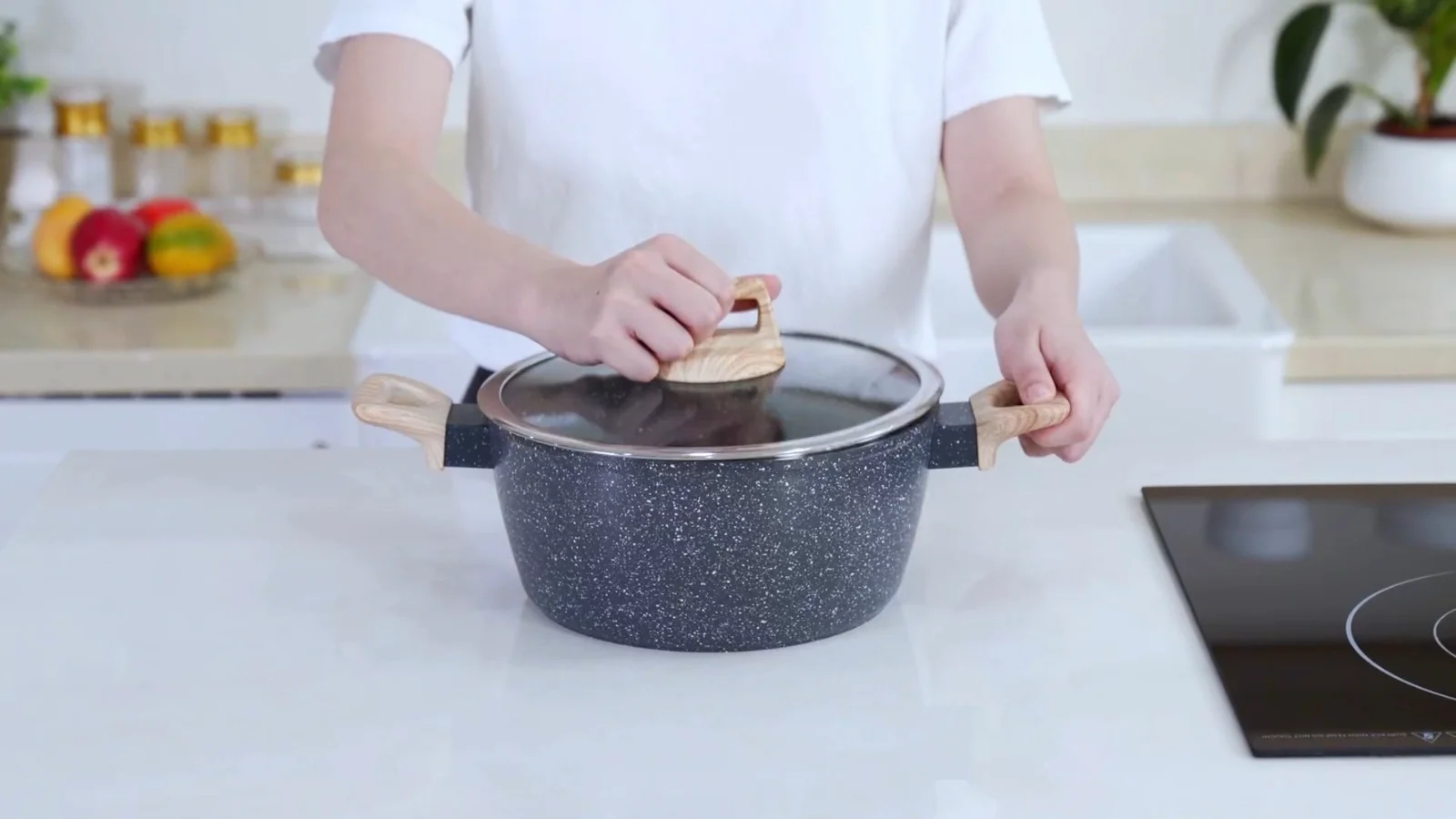
A set outlives its coating only if the supporting cast is cared for too, and each part has its one rule. Tempered glass lids are tough against heat and fragile against edges: they ride in the dishwasher happily, but in the cabinet they stand in a rack or lie on the stack top, never wedged rim-down against metal, and a lid that takes a hard corner knock should be inspected around its rim before its next boil. The steam vent occasionally clogs with starch after a pasta night. A toothpick clears it in five seconds.
Wood-look handles on the classic line ask only to stay out of standing water: hand wash, towel dry, done. They are stay-cool by design on the stovetop, and their enemy is the oven, so the classic sets are stovetop tools and the oven belongs to the pack-flat line. The click-off grips, in turn, like their sockets clean. A crumb in the socket makes the double lock feel gritty, and a rinse restores the click. Check the grip's action monthly with an empty pan, click on, lift, click off, and if years of service ever loosen it, the spare is a part, not a verdict.
Pan protectors, the felt discs, are washable: a run through warm soapy water when they pick up crumbs, dried flat, and they serve as long as the pans do. A lost one is replaced by a folded paper towel until the drawer produces it again. What matters is that something soft lives between nested surfaces every single time.
The spray varnish nobody suspects
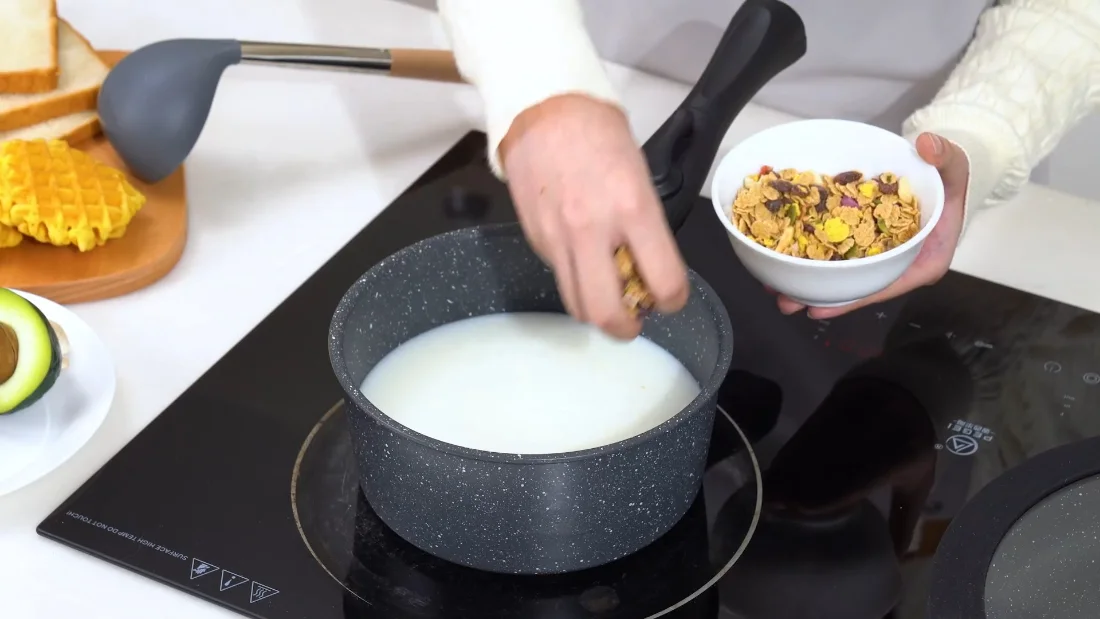
There is a failure mode that looks exactly like a dead coating and is not: aerosol cooking spray. The emulsifiers and propellants in spray cans polymerize at the rim of the heat zone into a thin amber lacquer that builds with every use. The center of the pan still releases. The shoulder develops a sticky halo. The owner reasonably concludes the nonstick is failing. It is varnish, not failure.
Prevention is easy, pour or brush oil instead of spraying, a teaspoon does the job on an intact coating. Removal, if the halo already exists: warm water, a drop of dish soap, a soft sponge and patience, repeated over a few washes. For stubborn lacquer, a paste of baking soda and water rubbed gently with the sponge, then rinsed well. What must not chase the varnish is steel wool, which removes the lacquer and the release layer together and converts a cosmetic problem into a real one.
Storage is half the lifespan
Cabinets kill more coatings than stoves do. A bare pan nested in a bare pan puts the hardest part of one body, the base rim, in grinding contact with the most delicate part of another, the release surface, and every open-close of the cabinet drawer files the two together. The fix ships in our boxes: pan protectors, the felted discs that sit between nested pieces. The twelve and thirteen-piece granite sets include four. The eighteen-piece pack-flat set includes five. Use them every time, and a nested stack becomes as safe as a row of hooks.
The pack-flat sets were designed around this problem, bodies nest into a single protected column, handles store flat in a drawer, and the geometry that saves up to 75 percent of shelf space also removes the leaning towers that scratch. The full packing order, protector by protector, is written out in the one-shelf kitchen, and it applies just as well to a full-size cabinet as to an RV galley.
Hanging is the other honorable option for fixed-handle sets: a rail and hooks keep every surface away from every other surface, and the white granite sets were half-designed for the look of it.
What the science says about the coating itself
Care guides for nonstick cookware eventually meet the question behind the question: is the coating safe to cook on at all? We would rather answer with the regulator's own pages than with a maker's reassurance, so here is the shape of it, with the FDA's documents linked below and read on the dates shown.
PFAS is a family of thousands of chemicals, and the FDA's overview page is plain that exposure to some types has been linked to serious health effects, and that is the reason the agency tests foods and reviews food-contact uses. For nonstick cookware specifically, the agency's food-contact review describes how these coatings are made, polymerized and bonded to the pan at very high temperatures, a process that drives off virtually all of the small migratable molecules, and concludes that studies show negligible amounts migrate to food from the finished coating. That is the regulatory frame every legitimate nonstick pan in the country cooks inside.
Our own materials promise sits on top of that frame, not instead of it: the coating spec for our sets is written without PFOS, PFOA, lead or cadmium, the pack-flat line extends the list to PFAS in its spec sheet, and the granite sets are tested against the spec by SGS, an independent lab. Care connects to chemistry in one practical place: an intact, unscorched coating is the one all of those documents describe, which is one more reason the heat discipline in the first section is the habit that matters most.
Hard water and the white ghosts
In hard-water regions, coated pots develop pale mineral spots and a chalky ring at the waterline of whatever simmered longest, and worried owners read the marks as coating failure. They are calcium, sitting on top of the surface, and they wipe away with the mildest acid in the kitchen: a splash of white vinegar on the sponge, or a simmer of one part vinegar to three parts water for five minutes in a pot that has built a real ring. Rinse, dry, and the speckle is itself again. Towel-drying after each wash prevents the spots entirely, which is one more argument for the thirty-second hand routine over air-drying in a rack.
When a pan has earned retirement
Coatings are consumables, measured in years when treated well, and an honest maker says so. The signs that a piece is done are visual and simple: the release surface worn through to metal in the wear zone where the spatula lives, deep scratches that catch a fingernail, or a coating that flakes at a damaged spot. A pan showing those signs has finished its service, and the graceful exit is to recycle the aluminum body where your area accepts metal and let the set continue without it.
Short of those signs, most "dead" pans are recoverable: the spray varnish above, a residue film from machine detergent, or a scorched patch that a warm-water soak releases. And one retirement that should never happen is the handle: on our pack-flat sets a worn or tired grip is a $19.99 spare part in the same 22-pound double-lock spec, not a reason to replace five healthy vessels. Sets that can be kept in service are the cheapest sets anyone owns, which is the quiet philosophy behind the whole of SODAY cookware.
The care calendar
Everything above compresses into a schedule short enough to live on a fridge door.
| How often | The habit | Why it works |
|---|---|---|
| Every cook | Medium heat, oil poured not sprayed, silicone or wood at the surface | Keeps the coating in the temperature and wear band it is built for |
| Every wash | Two-minute cool-down, warm water, soft sponge, towel dry | No thermal shock, no abrasion, no standing water at the rim |
| Every cabinet | A protector between nested pieces, or a hook per pan | Storage contact is the quietest coating killer |
| Monthly | A glance at the wear zone under good light | Catches spray varnish and scratches while they are still cosmetic |
| Yearly | An honest audit of each piece | Retire what is truly worn, order a spare handle instead of a new set |
A five-year pan is not a lucky pan. It is an ordinary pan owned by someone who cooled it before washing, stacked it on felt, and never let it preheat empty while the group chat was interesting. That someone can be anyone, starting tonight, and the pan will keep the receipts.
