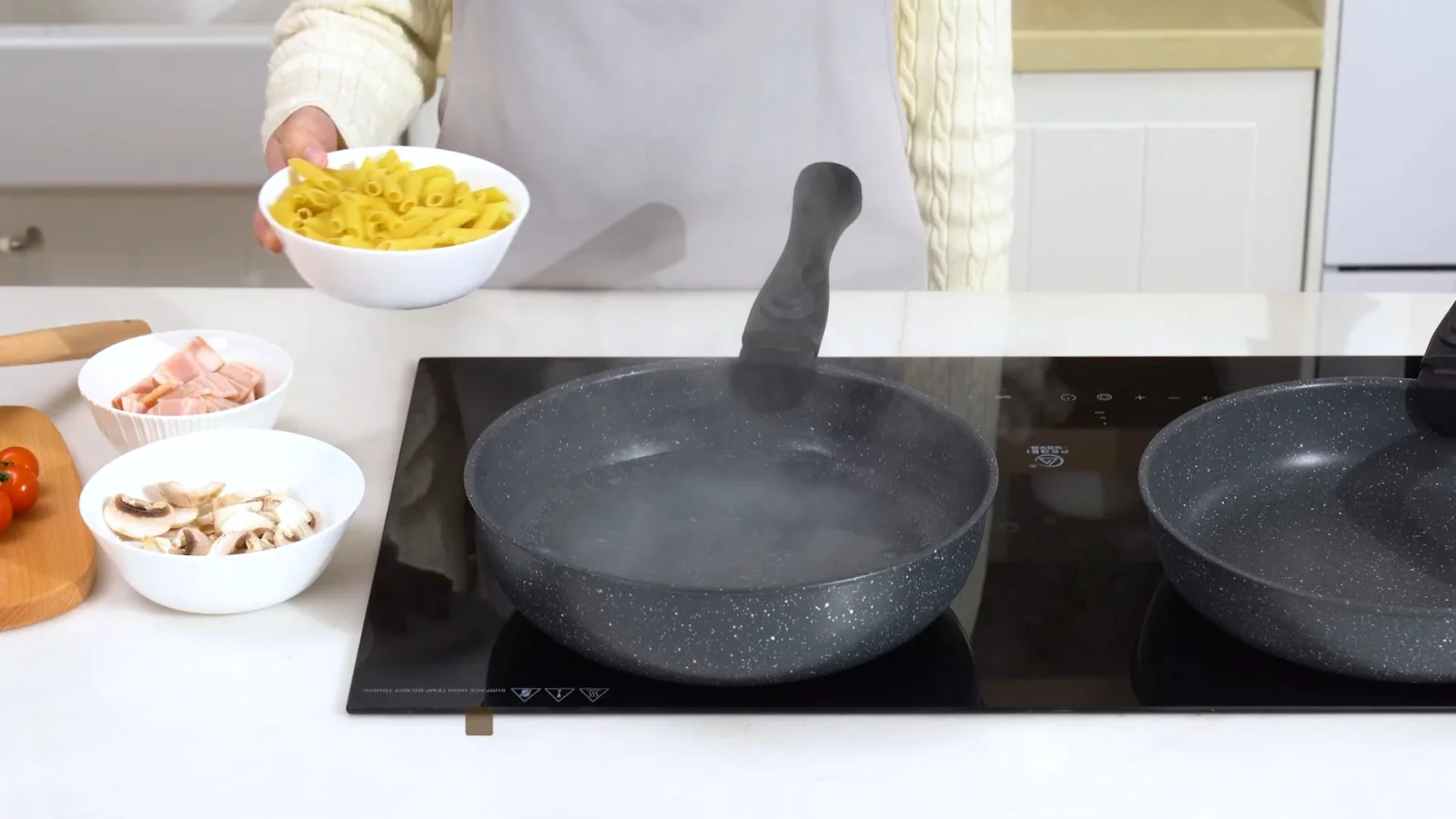
- The handle was the problem all along
- What fifteen pieces actually cover
- The nesting order, once
- Two burners, whole dinners
- The first-apartment kitchen, itemized
- Moving day, weight and the box
- When guests outnumber burners
- The fridge is part of the kitchen
- The oven trick
- When the fixed handle is right
- The checklist, before you choose
The American kitchen has been shrinking at both ends of life: the first apartment with its two burners and one drawer, and the RV or camper galley where the entire kitchen shares a wall with the bed. The cook in those kitchens has not shrunk at all. The appetite is the same, the guests still come, and the difference between cooking well and surrendering to takeout is mostly a storage problem wearing a cooking costume. We solved that storage problem in the SODAY pack-flat sets the blunt way: take the handles off, nest the bodies, and give a whole kitchen back one shelf at a time.
The handle was the problem all along
Lay a conventional frying pan in a cabinet and measure what it actually occupies. The body is a disc a couple of inches tall. The handle turns that disc into an L-shape that refuses to stack, tips the pan above it, and wedges against the door. Multiply by five pans and the cabinet is full of geometry, not cookware.
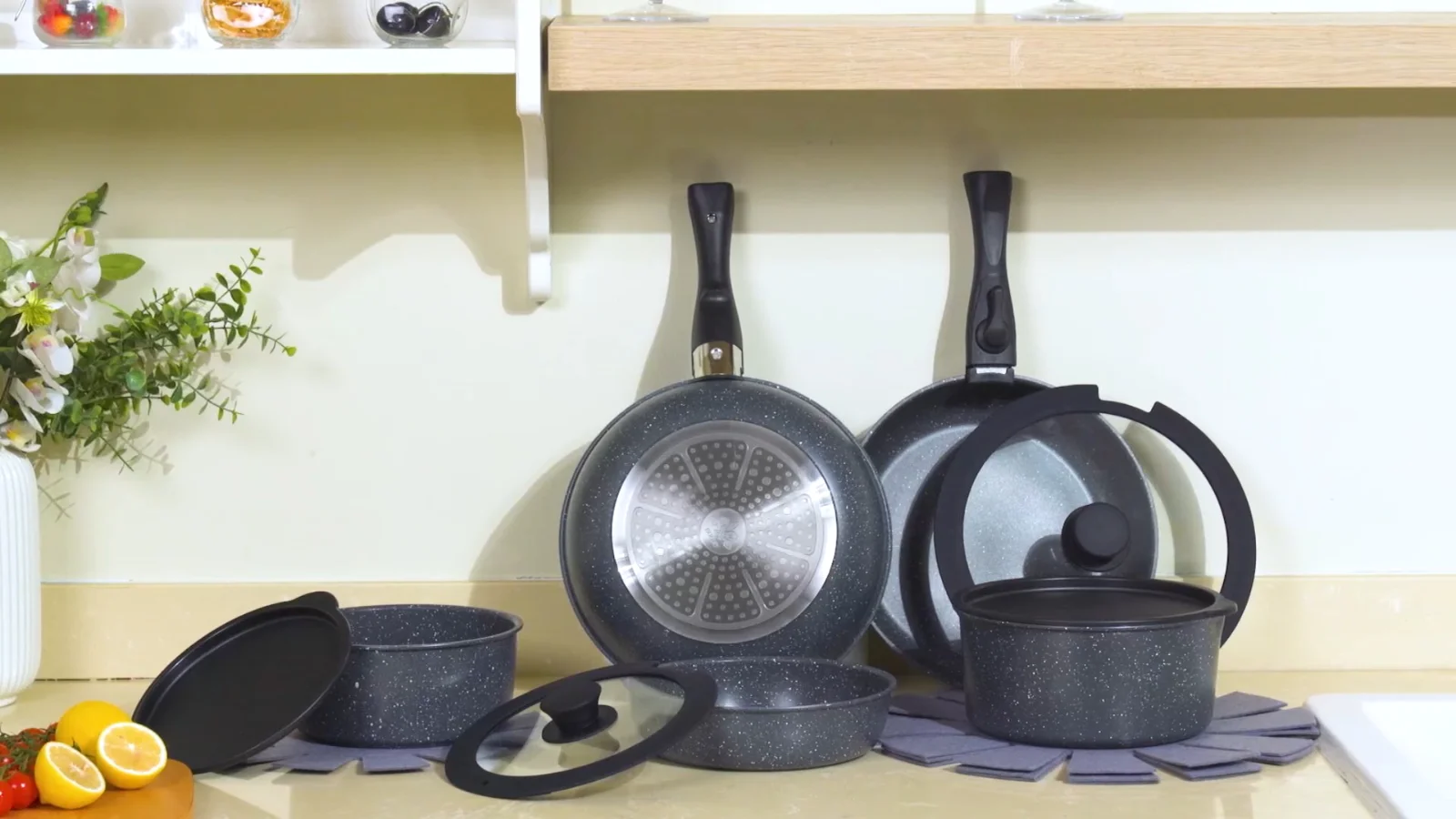
The pack-flat idea removes the geometry. Every body in our detachable sets is a straight-walled vessel with two small sockets where a handle clicks in, and the handle itself lives in a drawer, flat as a spatula. Two handles serve the entire set, because you only ever hold two pans at once. Bodies nest inside one another with a pan protector between each pair, lids stand on top, and the column that results is the reason our spec sheet talks about saving up to 75 percent of cabinet space. That is not a marketing rounding: it is what happens when eleven L-shapes become one cylinder.
The click deserves respect, because a detachable handle is only as good as its worst moment, which is a full pot moving from the stove to the sink. Ours engages in one motion and locks in two stages, so a bumped lever cannot release it, and the grip is rated to 22 pounds. No pot in the range can hold 22 pounds of dinner. The margin is the point. The same grip is sold on its own as a spare for $19.99, which means a handle that wears out years from now retires a part, not a kitchen.
What fifteen pieces actually cover
Piece counts are the most inflated number in cookware, so here is ours unpacked honestly. The fifteen-piece pack-flat set contains: an 11-inch saute pan, 8-inch and 10.6-inch frying pans, 2-quart and 3-quart saucepans, two click-off handles, two tempered glass lids sized 8.7 and 11 inches, two flat fridge lids, and four pan protectors. Count the vessels and it is five. Count what the five do and it is a kitchen.
| The piece | Weeknight jobs it owns |
|---|---|
| 8-inch frying pan | Eggs for one or two, a grilled cheese, reheating a slice properly |
| 10.6-inch frying pan | Family omelets, pancakes in pairs, a seared salmon fillet |
| 11-inch saute pan | Stir-fries, braises, one-pan pastas, anything with a sauce and a lid |
| 2-quart saucepan | Oatmeal, rice, two servings of soup, milk for cocoa |
| 3-quart saucepan | Pasta for the table, batch beans, the vegetable side |
The eighteen-piece white version stretches the same logic for bigger households: a third saucepan at 4 quarts, three glass lids instead of two, five protectors, and a fridge storage lid, in white granite that looks deliberate on an open shelf. Between the two sets, the honest selector is the number of people who regularly eat at your table: two people rarely miss the third saucepan, four people use it nightly.
The nesting order, once
Packing a nesting set is a thirty-second job after you have done it once, and a small puzzle the first time, so here is the order that works. Largest body on the shelf first: the saute pan. Protector in, then the large frying pan, protector, small frying pan. The saucepans stack the same way beside or inside, depending on your shelf depth, protector between each. Handles click off and lie flat in the drawer with the spatulas. Glass lids stand vertically at the back of the shelf or lie on the top of the column. The flat fridge lids slide beside them in the same slot.
Two rules keep the system healthy. Always use the protectors: bare granite stacked on bare granite grinds speckle against speckle, and the coating you protect is the coating that stays nonstick, a subject the care guide treats at full length. And never nest a pan that is still warm. A two-minute wait costs nothing and spares both surfaces.
A small kitchen is not a lesser kitchen. It is a kitchen with no room for bad geometry.
Two burners, whole dinners
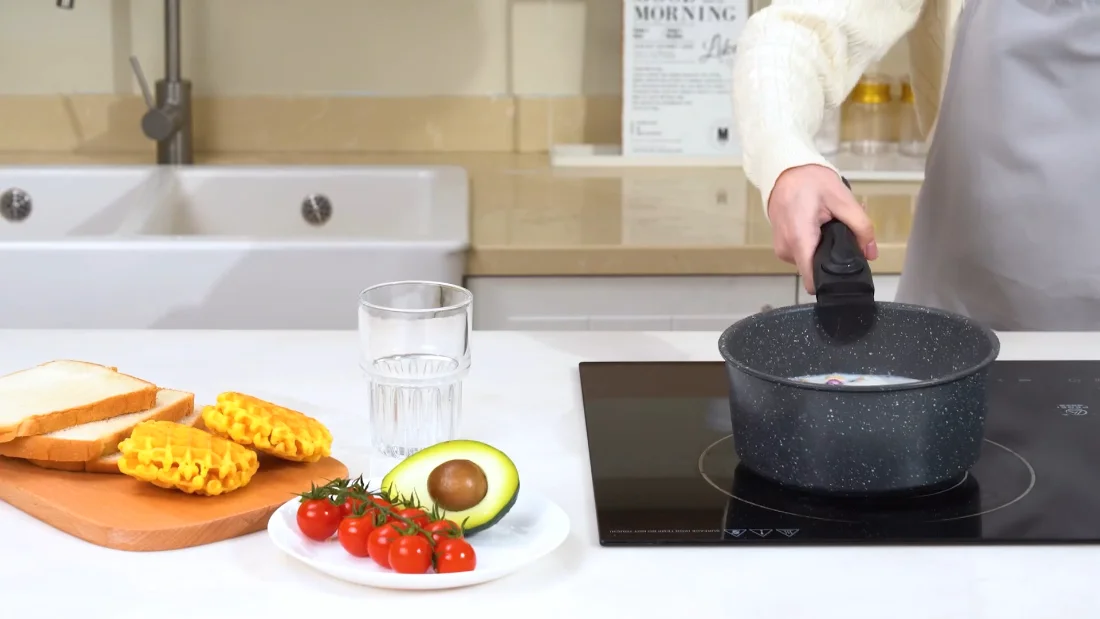
Cooking small is a sequencing skill more than an equipment problem. With five vessels and two burners, the plan is: the long job starts first and moves to the back burner, the fast job finishes in front. Pasta water boils behind while the sauce builds in the saute pan in front. Rice steams at the back on low, lid on, while chicken sears ahead of it. Oatmeal holds on the back corner while eggs set in the small pan.
The back-burner habit happens to be a safety habit as well, and the fire administration's cooking page, linked at the end, is the reason we phrase it as a rule: handles turned toward the back of the stove, so nothing in a narrow galley can catch one in passing. In an RV, where the aisle brushes the stove, the pack-flat sets add their own version of the rule, click the handle off any pot that is simmering unattended, and there is simply nothing to catch. The same page's first rule, stand by your pan, matters double in a small space where the smoke alarm and the bed share a ceiling.
A week of two-burner dinners from our own testing, all on the fifteen-piece set: Monday, one-pan pasta in the saute pan with the 3-quart saucepan steaming broccoli behind. Tuesday, rice at the back, stir-fry in front, one lid moving between them. Wednesday, beans reheated in the 2-quart while quesadillas turn in the big frying pan. Thursday, salmon in front at medium, couscous off-heat behind, done before the table is set. Friday, pancakes in both frying pans at once, because both handles were in the drawer waiting.
The first-apartment kitchen, itemized
The starter kitchen deserves its own accounting, because it is furnished all at once, on a budget, usually in a weekend. The trap is buying it piecewise: one pan this month, a pot the next, a lid that fits neither, until the drawer holds eleven orphans and no system. A set solves the system problem in one box, and the arithmetic favors it hard: our fifteen-piece pack-flat kitchen is $49.99 complete, which is less than many single branded frying pans, and it arrives already knowing how to store itself.
What the first kitchen actually needs, in order: something to boil (the 3-quart saucepan), something to fry (the 10.6-inch pan), something to sauce and braise (the saute pan with its lid), and then the small conveniences, the 8-inch pan for solo eggs, the 2-quart for oatmeal and packet noodles cooked honorably. The fifteen-piece box covers the whole ladder. What the first kitchen does not need is the aspirational hardware, the stockpot for the broth you will make someday, the wok for the burner you do not have. Buy the someday pieces when someday schedules itself.
There is also a quiet graduation built into this range: the skills learned on a starter set transfer without translation, because the coating and the cast body are the same spec as the larger kitchens. The student who learned eggs-on-medium-low in a dorm carries the same dial habits to the eighteen-piece family kitchen years later, and the two handles from the first box still fit every body we make in the pack-flat line.
Moving day, weight and the box
Small-kitchen cookware gets moved more than any other kind: apartment to apartment, home to campsite, camper to storage and back each season. Die-cast aluminum is the right metal for that life for a reason beyond heat: the whole fifteen-piece kitchen weighs what two pieces of cast iron weigh, and it packs itself. The nesting column that lives on a shelf is also a moving box in waiting, bodies nested on their protectors, lids flat, handles in a freezer bag so they do not wander.
For seasonal RV and camper storage, two habits keep the set fresh for spring. Wash and towel-dry every piece before it nests, because a drop of water sealed between two coated surfaces over a winter leaves a mineral ghost. And store the column with the fridge lids on loosely rather than clamped, letting air move. A sealed damp pot is the only way this cookware has ever come back from storage smelling like the lake. Neither habit takes five minutes, and both are the difference between opening-day pancakes and an opening-day scrubbing session.
When guests outnumber burners
The small-kitchen host's real constraint is not seats, it is simultaneous heat. The playbook that works: choose a menu where only one dish needs a burner at the end. A braise or curry holds in the saute pan on low, lid on, for an hour without complaint. The 3-quart of rice sits off-heat, steaming itself done. Only the last-minute green thing needs live flame while guests arrive. Our glass lids earn their keep here twice, once for the visible simmer and once because a lidded pot on low is a pot nobody has to watch, which in a galley kitchen means the cook gets to attend their own dinner.
The serving move borrowed from restaurant pass-throughs: with the handle clicked off, the saute pan goes from stove to trivet and becomes the serving dish, wide, warm and honest. One less platter to wash is one more inch of counter, and in a small kitchen the counter is the true currency.
The fridge is part of the kitchen
The quietest pieces in the pack-flat box are the flat fridge lids, and they solve the dish nobody counts: the transfer container. In a full-size kitchen, leftovers migrate from pot to plastic tub, adding a container to wash and a cabinet of mismatched lids to maintain. In the pack-flat system, the saucepan that cooked the beans gets a flat lid and goes onto the fridge shelf as its own container. The handle clicks off, so it stores flat like a bowl. Next evening it returns to the burner, lid swapped, no third vessel involved. Reheat leftovers fully, to 165°F by the federal chart we link below, and the pipeline from stove to fridge to stove runs on two washes a day total.
This is also where the granite coating quietly earns its keep twice: a surface that releases food when hot also releases cold refrigerated food, so yesterday's rice comes out of the pot instead of being chiseled.
The oven trick
With the handle off, the pack-flat bodies are oven safe to 480°F, and that number changes what a small kitchen can attempt. A chop seared two minutes a side in the big frying pan finishes in a 400-degree oven while the burner starts the vegetables. Cornbread bakes directly in the saute pan. A frittata sets on the stovetop and browns under the broiler's neighborhood, and the pan arrives at the table as the serving dish, wood trivet underneath, handle clicked back on for the carry.
The one discipline the trick requires is remembering that an oven-hot body has no cool handle until you give it one: click the grip on for the carry, and it is a handle again. Grab the bare socket with a towel out of habit and you will only do it once. We put that sentence in the box literature and we repeat it here on purpose.
When the fixed handle is right
Honesty about our own range: the pack-flat system is a storage solution, and if storage is not your bottleneck, the classic line is the better buy. The twelve-piece black granite set gives you the same coating and the same cast body with fixed wood-look handles that never need clicking, and its rating pool is the largest across SODAY cookware for a reason: most kitchens are medium, and a medium kitchen wants the plain thing done well. The seventeen-piece version adds the steamer and utensils for households that cook in volume.
The selector we give friends is one question long: does your cookware currently live somewhere it does not fit? If yes, pack-flat, fifteen pieces for one or two people, eighteen for a family. If no, classic granite, twelve pieces to start. Either way the technique carries over, the coating is the same, and the guide to cooking on it, heat, oil and the quiet pan, reads the same on both.
The checklist, before you choose
Whatever cookware ends up in your small kitchen, ours or not, the questions worth asking fit on a card, and we would rather hand you the card than the slogan.
| Ask this | Because |
|---|---|
| Does it nest, and with what protection between pieces? | A set that cannot stack is furniture, not cookware, in a galley |
| Does one lid serve more than one vessel? | Shared lids are how five pieces act like eight |
| Will it work on the stove you have and the next one? | An induction disc is moving insurance, a converter plate is a regret |
| What is the oven limit, stated in a number? | "Oven safe" without a number is a shrug in typeface |
| Is any part sold as a spare? | The answer predicts whether the maker expects the set to last |
| How heavy is the largest piece, full? | A pot you hesitate to lift is a pot you stop using |
Run our own fifteen-piece kitchen against that card and you will see why each line is there: nesting with protectors in the box, two glass lids across five bodies, the full induction disc, 480°F in print, the $19.99 spare handle, and cast aluminum light enough that the big saute pan full of stew is a one-hand carry. The card is still yours to keep for every future kitchen.
Small kitchens run on subtraction: fewer vessels doing more jobs, less geometry in the cabinet, nothing on the counter that does not earn its footprint daily. A range built for that arithmetic does not feel like a compromise. It feels like the first kitchen you have owned where everything has a place, and the place is one shelf.
